

Libels are not lies. Lies are untruthful statements. Libels are defamatory accusations that use snippets of truth to run an intensive propaganda campaign against a group of people to inflict significant harm on them. There are several definitions of the word libel, but few reveal how a libel functions. In a recent lecture I gave on the history of the blood libel and the modern genocide libel, I realized that every enduring libel relies on the interplay of three elements: ethos, logos, and pathos. Borrowing from Aristotle’s framework of rhetorical persuasion, these three appeals, an authority figure, logical structure, and moral force, must coexist and reinforce one another. Their integration is what gives a libel its power.

If we apply Aristotle’s rhetorical triangle to the mechanics of a libel, we can see how a libel must have all three in order to function effectively.

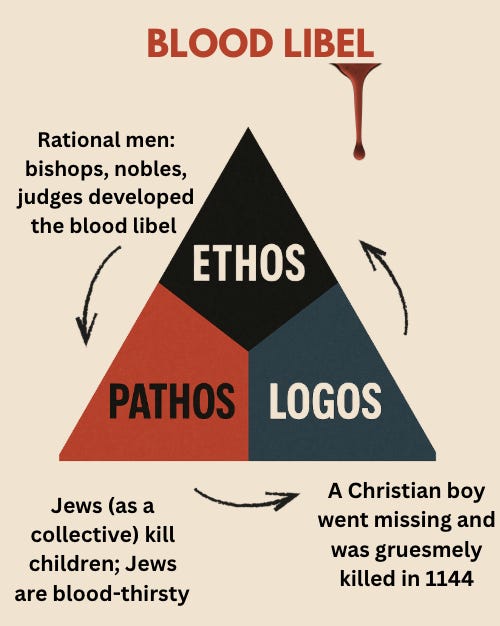
Consider one of the first anti-Jewish libels from the era of anti-Judaism: the blood libel. This accusation followed a familiar structure: an event occurred, a figure of authority validated it, and a sweeping moral judgment was directed at an entire people.
Indeed, in 1144, a young boy named William went missing in the town of Norwich. When his body was later found, crucified and drained of blood, the story acquired its logos, the purported “evidence.” In 1170, a traveling monk elevated the tale by portraying the boy as a saint, giving the libel its ethos: the authority needed to legitimize the accusation. What followed was hysteria and fear, as the narrative assigned a sinister moral character to the Jewish community. This is the pathos, the emotional force that turned an accusation into a communal panic.
Consider the Doctor’s Plot libel. In 1951, Soviet leader Joseph Stalin launched what became known as the Doctor’s Plot. Suspicious of Jews in the Soviet Union and convinced they constituted a “fifth column,” Stalin manufactured a defamatory accusation designed to incite irrational fear of Jews among the Soviet population. He alleged that Jewish doctors were conspiring to harm top Soviet officials, branding them “murderers in white robes” and accusing them of poisoning Kremlin leaders.
Like the medieval blood libel, the Doctor’s Plot relied on ethos, logos, and pathos. When Andrei Zhdanov, widely regarded as Stalin’s right-hand man, died of heart failure in 1948 while under the care of a Jewish doctor, this detail became the logos, the supposed “evidence” used to set the libel machine in motion. Stalin then provided the ethos, lending the accusation the authority it needed to appear credible. Within weeks, Jewish doctors were fired or dismissed from hospitals as the libel spread, generating widespread fear. This communal panic, the pathos, was the emotional force that transformed a fabricated accusation into a nationwide hysteria, for Jews were assigned moral ugliness.
In the era of antizionism, accusations such as genocide, colonizer, apartheid, baby-killer, and ethnic cleansing function as libels designed to activate the full triad of persuasion: ethos, logos, and pathos. The genocide libel, for example, has been leveled against Israel since its founding. Most recently, it acquired a semblance of institutional credibility when South Africa filed a genocide case against Israel before the International Court of Justice (ICJ) on December 29, 2023, supplying the accusation with its ethos. As with the blood libel and the Doctor’s Plot libel, a concrete event, in this case, the deaths of thousands of Gazans, served as the supposed evidence, providing the libel with its logos. And because the charge of genocide evokes profound moral outrage, pathos becomes the final mechanism that locks the libel into place.
Logos: Critically, libels don’t work despite snippets of truth, but because of them. A libel does not fabricate reality from nothing; instead, it seizes on fragments of truth, an event, a detail, an absence of something essential, or a death, and repurposes them into a narrative of guilt. This is why libels are so resilient: they attach themselves to something real, however distorted, and then replace it with a meaning that serves a political or ideological purpose.
Ethos: No less important is the role that institutions and figures of authority play in spreading libels. Their endorsement gives libels the power to spread rapidly through authoritative channels, from medieval churches to twentieth-century state propaganda to today’s international courts of justice.
Pathos: Assigning moral ugliness to a group is the final lock that keeps the libel fastened. Once a group is portrayed as inherently depraved—cruel, bloodthirsty, treacherous, genocidal—everything else falls into place. The libel no longer requires proof; it requires only repetition. The targeted group becomes not a collection of individuals but a type, a morally diseased category whose alleged crimes flow “naturally” from who they are. It seals the libel into the public imagination by reshaping how people feel about the accused. And once a feeling has taken root, no amount of factual correction can dislodge it, for people do not reason their way out of moral revulsion.
Indeed, throughout history, the pattern has been consistent:
Jews in Medieval Europe were not just accused of killing Christian children; they were said to crave their blood.
Stalin did not merely frame Jewish doctors as negligent; they were described as “murderers in white coats,” animated by an inner hatred of the Soviet people.
Israelis and often Jews collectively are not accused of military wrongdoing; they are framed as baby killers, genocidal colonizers, Nazi-like.
Most importantly, libels predict the violence that will follow against the group they demonize:
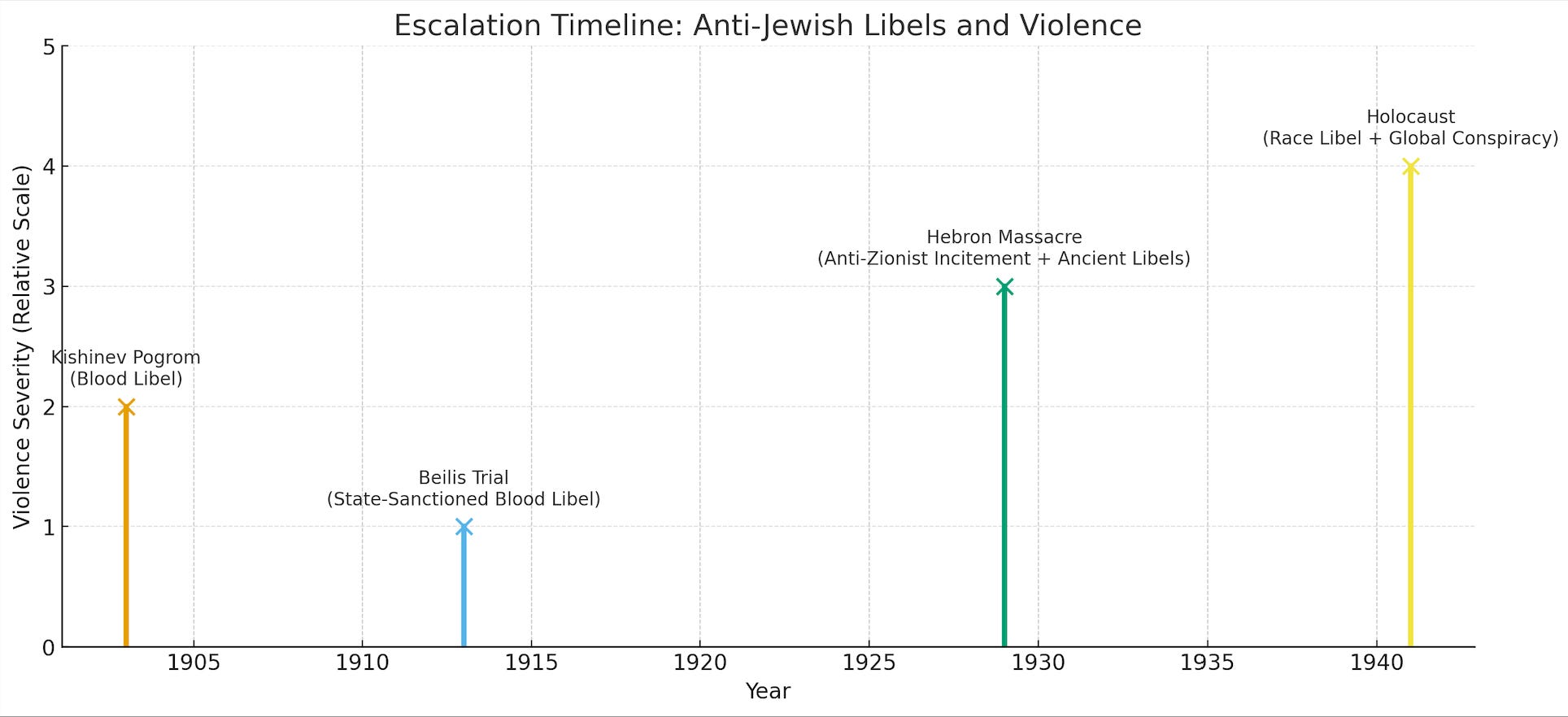
The chart above looks at key events in which Jews were attacked: the Kishinev pogrom in 1903; the Beilis Trial (blood libel charge) in 1911 in Kiev, Russia; the Hebron Massacre in 1929 in Mandatory Palestine, and the Holocaust. In each case, a libel or several libels at once precipitated each violent anti-Jewish event:
The Kishinev Pogrom in 1903, in which close to 50 Jews died and 500 were injured, followed the alleged discovery of a master plot, the Protocols of the Elders of Zion, a fabricated document portraying Jews as conspirators bent on global domination, a narrative encouraged by the Tsarist regime.
The Black Hundreds, emboldened right-wing Russian mobs sent by Tsar Nicolas II, normalized antisemitic attacks against Jews in the Russian Empire. Their campaign unfolded as Menahem Mendel Beilis was falsely accused of murdering a 13-year-old Christian boy in Ukraine, further inflaming anti-Jewish hostility.
The 1929 Hebron Massacre was sparked by the Al-Aqsa libel, in which Haj Amin al-Husseini, the Grand Mufti of Jerusalem, falsely claimed that Jews intended to take over the Al-Aqsa Mosque and replace it with their Third Temple.
The Holocaust, the most extreme eruption of violence against Jews in the twentieth century, was driven by a Nazi state that relentlessly broadcast the race-polluter and Jewish plot for global domination libels.
Most importantly, the libel justifies the violence. It is the moral blueprint for action because when ethos, pathos, and logos converge, the libel becomes a license for action. It renders violence not as a breakdown of order but as its restoration. The solution to the problem the libel has invented is thus violence.
Libel life cycle: distorted fact -> prestige, emotion, repeat -> hysteria -> violence -> denial/Jew-blame --> rinse and repeat...
Wow. What an impressive post. Thank you!