
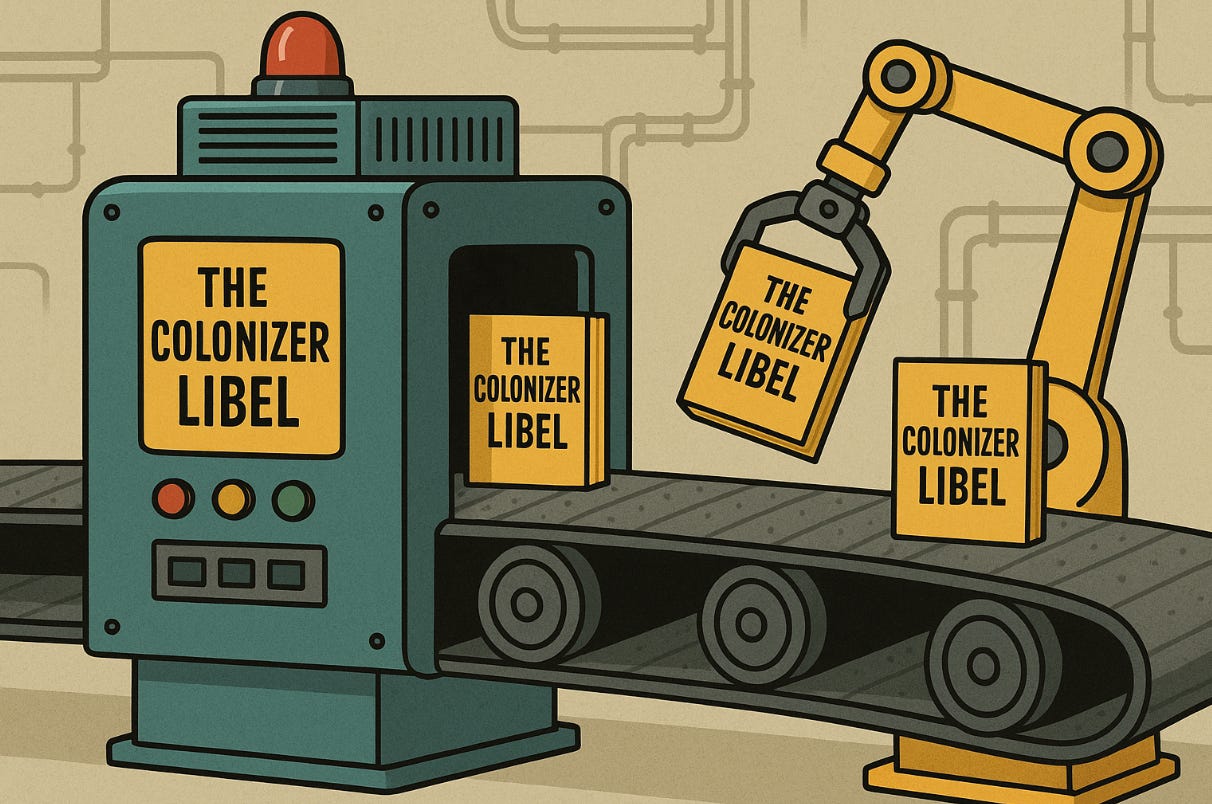
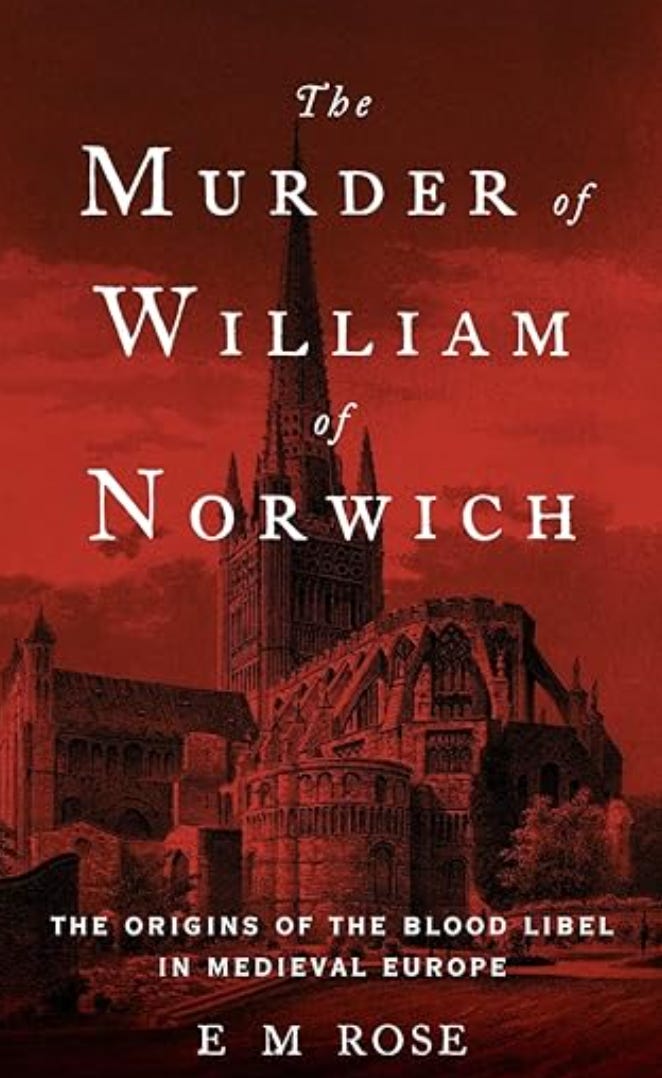
Every libel requires a precondition, a certain preparation to make the ground fertile for the libel to take root. Consider blood libel, which emerged in 12th-century England. What prepared the English imagination so that such a charge could suddenly seem plausible? Historian E. M. Rose argues that the initial spread of the idea was inseparable from the era’s financial tensions. Jews, barred from most professions, became moneylenders, and the crushing financial fallout of the failed Second Crusade left many Christians deeply indebted. As resentment toward Jewish creditors intensified, the social and economic hostility created precisely the conditions in which a libel could flourish. In other words, the blood libel did not arise in a vacuum; it grew out of a landscape already primed by anger, debt, and the need for a scapegoat.
But economic tension alone does not explain the extraordinary power of the blood libel. Its potency lay in the fact that it was framed within religious language and imagery. The accusation was not merely that Jews had killed someone; it was that they had murdered a child, elevated to the status of a saint, and that his death was woven into a sacred narrative. Thomas of Monmouth’s The Life and Passion of William of Norwich (1170s) transformed an unexplained death into a hagiography. This religious framing made the accusation resonate far more deeply, especially in a world where, as E. M. Rose notes, “it was common for unclaimed bodies to appear in forests or fields and for passersby to simply move along.” The libel’s force, then, came not from the presence of a corpse but from the interpretive lens through which that corpse was recast.
We know that each era of Jew-hatred invents its own signature libels. In the anti-Judaism era, they were the Christ-killer libel and the blood libel; in the antisemitism era, they became the race-polluter, globalist, and dual-loyalty libels; and in the antizionism era, they appear as the colonizer, genocide, apartheid, and ethno-state libels. On the genocide libel, a group of scholars, namely Jeffrey Herf and Norman JW Goda, connects the modern accusation against Israel to Soviet and Arab propagandists, evincing that the reason, much like the original blood libel, that this genocide libel stuck was that despite carnage worldwide (note the similarity to the blood libel context in which violence was likewise rife at the time), the Jews were once again accused of killing the innocent: children in Gaza.
A corollary of the genocide libel and perhaps even a more dangerous one is the colonizer libel, which casts Jews as foreigners in their indigenous homeland. Indeed, branding Israel a settler-colonial state would mark the first instance in the history of settler-colonialism where the identity of the “colonizer” is, in fact, a people returning to their ancestral land. But how is this libel made possible? And just as historians ask what conditions made the blood libel believable to the medieval English imagination, we must ask: what prepared the modern Western imagination to accept, so readily and so confidently, the charge that Jews are “colonizers” in the land to which they are native?
Critically, the colonizer libel could only emerge once a prior narrative had been successfully installed: the denial of Jewish peoplehood. Before Jews could be recast as “colonizers,” they first had to be stripped of what they have always been: a nation with an ancient, continuous, and documented relationship to the land of Israel.
This denial narrative is foundational to the colonizer libel. It reframes Jews not as a people but as a mere religious group, detached from territory or history. By reducing Jewish identity to a set of theological beliefs, antizionist ideologues sever the link between Jews and their land, thereby creating the conceptual space necessary to invert history itself. Only after erasing the Jewish nation could these same actors then claim that Jews are foreign to the very land from which their language, rituals, memory, and law emerged.
Nevertheless, it would make for interesting detective work: to find the author of the colonizer libel, today’s equivalent of Thomas of Monmouth. Did such a person exist? Not quite. However, the pivotal figures here are Lenin and Stalin, both of whom forcefully denied that Jews constituted a nation. Each, however, in their own way. Critically, their aim was not to dispute Jewish indigeneity in the Land of Israel, nor to champion the “liberation of Palestine,” for such an idea did not exist. Rather, their motivations were rooted in communist ideology, which rejected national identity as a legitimate basis for collective belonging because within this framework, Jewish peoplehood was incompatible with the communist vision of humanity united as workers, stripped of particularistic ethnic or national attachments. In 1903, Lenin began to engage polemically with Zionism, a Jewish national movement. In “The Position of the Bund in the Party,” he issued what is arguably the earliest explicit Marxist formulation against the Jewish people. He explicitly names “the idea of a Jewish nation” as “the Zionist idea,” and vilifies it in unmistakably harsh terms, calling it “absolutely false and essentially reactionary.” Granted that Marxist-Leninism adopted a hostile stance to any national particularism that might interfere with proletarian unity, Lenin’s anti-Jewish nation attitudes shaped future intellectuals who would deploy the colonizer libel.
Ten years later, at Lenin’s request, Stalin wrote Marxism and the National Question (1913), in which he set out a four-part definition of a nation. According to Stalin, a nation requires: a common language, a common territory, a shared economic life, and a common psychological makeup. Jews, he argued, were “scattered” and therefore lacked a common territory; their economic life, he claimed, was not “homogeneous.” His conclusion was blunt: Jews “do not form a single, integral nation.” Whereas Lenin stopped short of denying Jewish nationhood outright, attacking instead the Jewish national movement, Zionism, as “reactionary” and incompatible with Marxism, Stalin advanced the argument further. He moved from maligning Zionism to categorically denying that Jews constituted a nation at all.
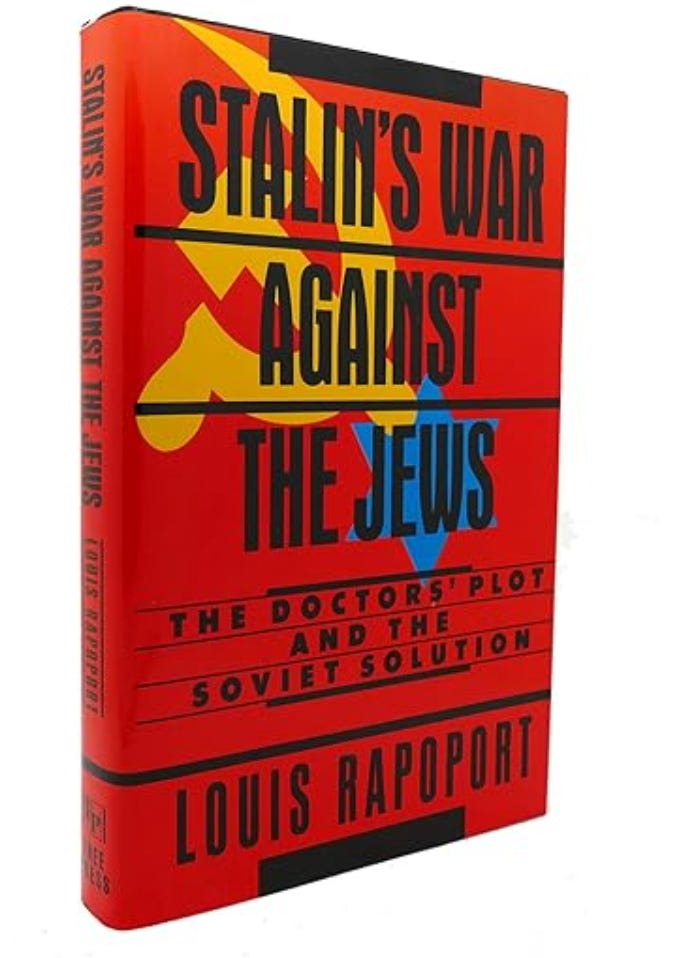
At this stage, the colonizer libel had not yet fully taken shape. Crucially, however, Lenin and Stalin could not have advanced the denial of Jewish nationhood without the participation from the Yevsektsiya, the Jewish section of the Communist Party. Its Yiddish-language newspaper, Der Emes, edited by Moshe Litvakov, became the primary platform for Jewish antizionism in the 1920s, helping to legitimize and circulate this narrative. It is in Der Emes that we find the earliest hints of equating Zionism with colonialism. Historians Zvi Gitelman and Jonathan Frankel both demonstrate that Der Emes consistently framed Zionism as a form of Western imperialism: as Gitelman notes, “the Yevsektsiya press regularly denounced Zionism as an instrument of British imperialism, financed by Anglo-American capital and serving the interests of world bourgeois society.” Frankel similarly observes that “for the Bolsheviks, and particularly for the Jewish sections, Zionism became synonymous with imperialist penetration in the Middle East. Zionist colonization was portrayed as an extension of British and, increasingly, American capitalist interests.”
This then is a crucial stage in retracing the assembly line of the colonizer libel: first, deny that Jews constitute a nation; next, recast Zionism as a colonial project. The fact that Jews themselves, through the Yevsektiya, participated in framing Zionism as colonialism was an added benefit, lending the narrative a legitimacy that neither Lenin nor Stalin could have supplied on their own.
Downstream from these necessary preconditions is the popularization of the phrase “Zionism is colonialism,” which entered global discourse through a coordinated series of pamphlets published by Novosti. These publications recast Zionism as racism, colonization, fascism, and imperialism. Yury Ivanov, author of Zionism: Beware! (1969), was among the earliest to label Zionism explicitly as a “colonial ideology” and “a form of aggressive colonial expansion in the Middle East,” making him one of the earliest architects of the colonizer libel. Here it is important to recognize that Ivanov’s Zionism: Beware! was a villain-manufacturing project, no different in spirit or purpose from the forged Protocols of the Elders of Zion, designed to alarm the world about supposed Jewish power and recast Jews, once again, as a global menace.
What followed were the parroters: secondary but necessary figures who repeated and amplified this libel until it solidified into a heuristic. Mikhail Smeylakov, Lev Korneev, and Andrei Gromyko all propagated the claim in their writings and speeches, helping to entrench the libel and ship it beyond the confines of the Soviet borders. Indeed, the pamphlets were distributed globally, especially across the Middle East, Africa, Asia, Western Europe, and university campuses in the West.
Next stop on the colonizer libel assembly line is Fayez Sayegh’s 1965 book Zionist Colonialism in Palestine. At this stage, the colonizer libel is fully entrenched, a given with which Sayegh engages: “Zionist colonization could not possibly assume the physical proportions envisaged by Zionism while the Arab people of Palestine continued to inhabit its homeland; nor could Zionist colonization admit indefinite coexistence with the inhabitants of Palestine.” And in the West, one of the most influential early Western texts to frame Israel through the lens of colonialism is Maxime Rodinson’s 1967 essay “Israel: A Colonial-Settler State?” Rodinson, a French Marxist scholar, observes that “the creation of the State of Israel was accompanied by the settlement of colonists who came from a different world into the Middle East.”
Crucially, Rodinson must confront the fact that the classic framework of colonialism, one that requires settlers acting on behalf of a political “mother country,” does not apply to Jews. Acknowledging this problem, he concedes: “It is true that the Jews had no mother country, yet the enterprise took on a colonial character because it involved Europeans establishing themselves among an indigenous population.” This redefinition of colonialism is hardly persuasive: by this logic, any migration from Europe would automatically become “colonial,” simply because newcomers arrive among an existing population.
Most significantly, however, Rodinson can make this conceptual leap only because he is working atop the scaffolding constructed by earlier efforts to deny Jewish history, peoplehood, and nationhood. And this, the erasure of Jewish peoplehood that enables the recoding of Jewish return as “colonization,” is the most consequential stage in the assembly line of the colonizer libel.
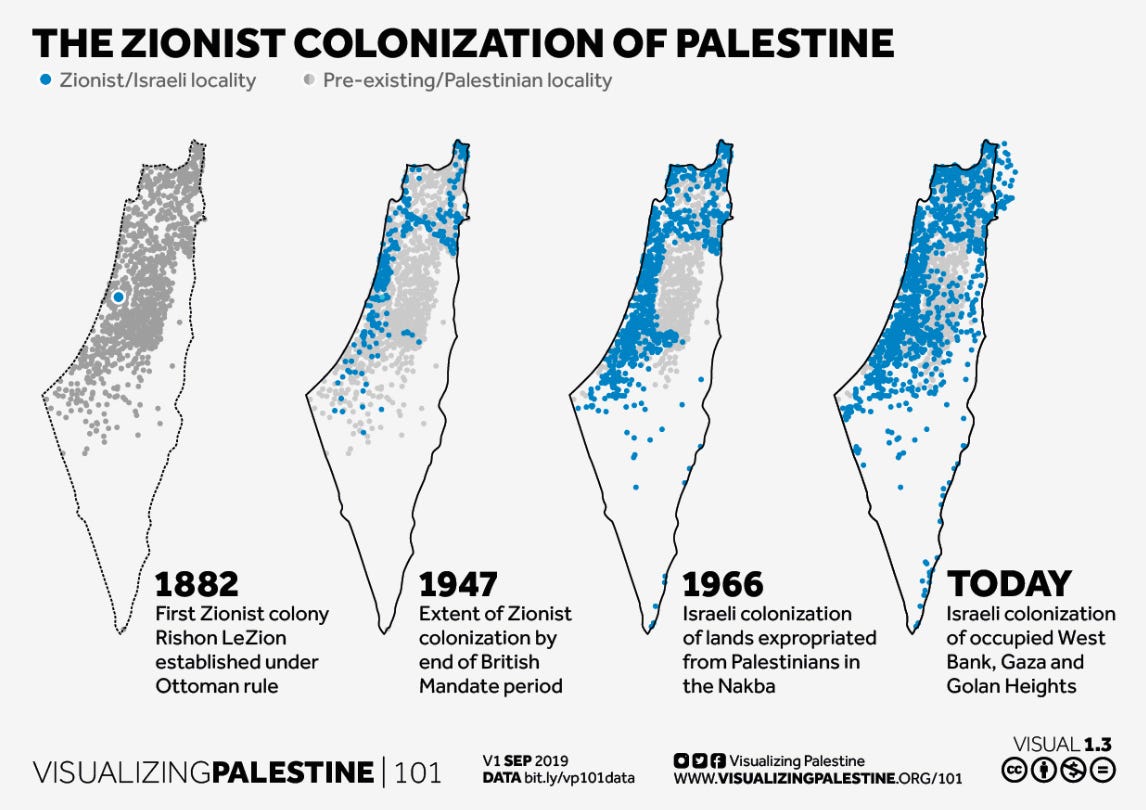
The colonizer libel is now fully operational. In school districts where Ethnic Studies is required for graduation, it appears in the curriculum, most notably in assignments such as the “Disappearing Map of Palestine.” What is striking is that this narrative is treated as an unquestionable doctrine. Anyone who dares challenge its legitimacy is immediately shut down. Yet the great irony is this: if today’s practitioners of the colonizer libel—teachers, professors, journalists—understood its actual origin story, how it was manufactured by one of the most ruthless and ideologically manipulative regimes of the twentieth century, the Soviet Union, they would shudder.
In this sense, the denial of Jewish nationhood becomes the essential scaffolding that allows the colonizer libel to flourish. It provides the conceptual legitimacy for recasting a people whose origins lie in Judea as Europeans who allegedly arrived as late-stage agents of Western imperialism.
All of this would matter little if antizionism were not, like its predecessors, antisemitism and anti-Judaism, about demonizing Jews on a cosmic scale, for in every era of Jew-hatred, the Jew is cast as violating the highest moral values of the age. And today, in the 21st century, decolonization is the reigning ideological liturgy.
Why nobody talks about Arab/Muslim colonisation?
Check your pronoun use for Maxime Rodinson